
BLOGAI & AUTOMATION
Your AI Worked. Did the Business Process?
An AI interaction can work perfectly while the business outcome still fails. Learn why successful automation needs to be measured end to end.
LANE 1 / THE CONVERSATION
LANE 2 / THE BUSINESS OUTCOME
- PUBLISHED
- CATEGORY
- AI & Automation
- READING
- 5 min
- DEMONSTRATION
- AI-Assisted Out-of-Hours Calls
AI systems are becoming very good at the part of a process that people can see. A voice assistant can hold a natural conversation, an email assistant can produce a polished reply, and a document-processing system can make sense of information that traditional software would struggle to read. Those capabilities matter, but they can also distract from a more important question: did the business process actually work?
For businesses adopting AI, that distinction is becoming increasingly important, because a successful AI interaction and a successful business outcome are not necessarily the same thing.
The impressive part is rarely the whole process
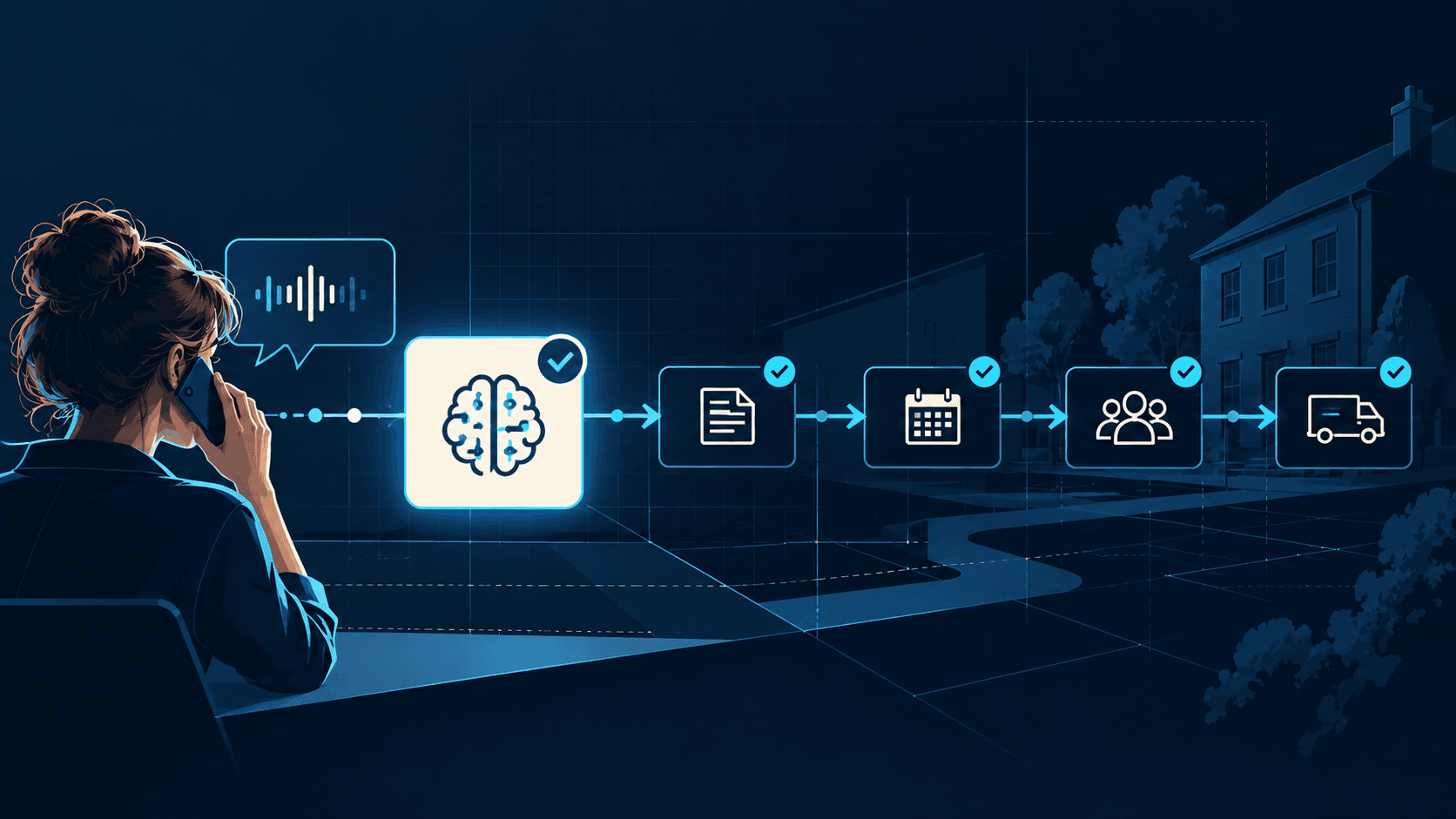
Imagine a customer calls a business outside normal working hours. An AI voice system answers, understands why they are calling, asks sensible questions, collects the relevant information and responds appropriately. From the customer's point of view the interaction may have been excellent, and from a technical point of view the language model may have performed exactly as expected.
Yet a good conversation was probably not the business objective. If the customer was reporting a problem that needed action, something had to happen afterwards. The information might need to reach an operational team, a service request might need to be created, a record might need updating, or an urgent situation might need escalating to someone with enough structured information to decide what happens next. Until that occurs, the AI has completed only one part of the journey.
AI performance and process performance are different things
The same distinction applies well beyond voice systems. A model might extract information from a document correctly, but does that information reach the right record? An email assistant might write an excellent draft, but does the surrounding process stop unsupported commitments being sent to a customer? A classifier might correctly identify an urgent request, but does the escalation reach somebody who can act on it? An agent might call an API successfully, but does the resulting state make sense across the wider business system?
These are different levels of success. One measures whether the AI performed its task; the other measures whether the organisation achieved what it set out to do, and that second measure is the one businesses ultimately care about.
Start by defining the outcome
That changes how an automation project should begin. Rather than asking what could be automated with AI, start by asking what needs to happen for the business process to be considered successful. The difference sounds small, but it can change the system you build completely.
For an out-of-hours service call, success might mean that the customer's problem is understood, the required information is captured, the appropriate safety rules are followed and the resulting request reaches the correct operational process. Once the outcome is defined, the role of AI becomes clearer. It may be extremely useful for understanding the customer's natural language, while other parts of the journey are better handled by deterministic software, APIs, validation rules, monitoring or human intervention. The architecture follows the outcome rather than the technology.
The handoffs matter
Many useful AI systems sit between people and conventional business software, so the boundaries between components matter enormously. A typical process might run:
Customer → AI interaction → structured data → workflow → business system → employee
Every arrow is a handoff, and every handoff is a point at which the complete process can behave differently from the individual component. None of this makes AI automation unusually unreliable. AI systems simply need the same engineering discipline we expect from any other business software: inputs need validation, integrations need failure handling, important events need to be observable, exceptions need somewhere to go, and the complete journey needs testing.
Test from beginning to end
This became an important design principle while we were developing XPLORATECH's own AI-assisted demonstrations. Testing whether the AI understood the interaction was not enough; we needed to know what happened afterwards. That meant checking each journey for the same things:
- whether the information had the structure we expected;
- whether deterministic validation accepted it;
- whether the correct route executed;
- whether the downstream handoff occurred;
- whether the resulting information could actually be used.
That is a much more demanding standard than showing a model can generate a convincing response, and it is much closer to how a business experiences the system. A customer does not care which individual component passed its test, and a business gets no value from a model returning the correct JSON. The value appears when the process achieves something useful.
Design the failure path as well as the happy path
Demonstrations naturally focus on what happens when everything works. Production thinking has to ask what happens when it doesn't: when a downstream service is unavailable, when the AI produces output that cannot be trusted, when a record cannot be matched, when information is missing, or when the situation is one in which AI should not continue.
There is no single right answer. Sometimes retrying is appropriate, sometimes deterministic fallback logic is better, sometimes the work should move to human review, and sometimes the correct behaviour is to stop. What matters is that failure is treated as part of the design rather than as an unexpected interruption to it.
AI does not need to control everything
Thinking about the complete business process has another useful consequence: you stop asking AI to do jobs that other software can perform more reliably. If a rule can be expressed precisely, deterministic code may be the better tool. If a database already holds an authoritative answer, retrieve it rather than asking a model to infer it. If an action carries meaningful business responsibility, human approval may be appropriate. AI then becomes one component in a deliberately engineered system rather than the system itself.
At XPLORATECH we describe this as AI where intelligence is useful, code where certainty is possible, and humans where judgement matters. The aim is not to limit AI but to use it where it adds the most value.
Measure the outcome that matters
As AI becomes easier to add to business processes, impressive demonstrations will become easier to create too. The harder work comes afterwards: making the system operate reliably around real business rules, identifying exceptions, helping people understand what happened, recovering from failures and producing information the organisation can trust. Above all, it means asking whether the thing the business actually needed to happen did happen.
That is a much higher standard than asking whether the AI worked, and it is the standard that turns an interesting AI capability into useful business automation. It is also where we believe the engineering should start: define the business outcome, engineer the complete process, and then use AI where it genuinely improves the solution.