
BLOGAI & AUTOMATION
AI Can Read the Data Without Controlling the Record
Learn why AI can interpret unstructured business information while deterministic software controls what actually enters the business record.
READ
CONTROL
UNKNOWN JOBREVIEW, NOT A GUESS
- PUBLISHED
- CATEGORY
- AI & Automation
- READING
- 6 min
- DEMONSTRATION
- AI-Assisted Post-job Administration
One of AI's most useful business capabilities is its ability to make sense of information that was never written for software. An engineer writes a few lines about a completed job, a customer explains a problem in an email, an employee adds notes to a case, a supplier sends a document in their own format. To a traditional software system that information is awkward; to a modern language model it can be remarkably accessible.
That creates a significant opportunity, but it also raises an important distinction. Being able to understand information does not mean AI should have unrestricted authority over the business record. Interpreting information and controlling what is recorded are different responsibilities, and separating them produces much more dependable automation.
Businesses contain huge amounts of unstructured information
Very little useful business information begins life as a database field. People write notes, send messages and describe what happened in their own words. They abbreviate, they leave out whatever they consider obvious, and they rarely structure a sentence to suit the schema of the system that will eventually consume it.
Historically, businesses have handled this in one of two ways. Someone reads the information and enters it into another system by hand, or the organisation introduces a rigid form and asks the person providing the information to structure it themselves. Sometimes that is entirely appropriate, but often it simply moves administrative work from one person to another. AI offers another possibility: let people provide information naturally, and use AI to help interpret it.
Interpretation is where AI becomes valuable
We explored this pattern while building XPLORATECH's post-job administration demonstration. In the fictional scenario, an engineer finishes a job and provides a job number, an explicit status and free-text notes describing the work.
The notes are the interesting part. Different engineers could describe exactly the same work in completely different ways: one writes complete sentences, another uses shorthand, one states explicitly that no materials were used and another simply doesn't mention materials at all. Accounting for every variation with conventional text rules quickly becomes difficult. AI is well suited to this part of the problem, because it can interpret the notes and turn the relevant information into a predictable structure. That does not mean the AI should decide everything that happens next.
Plausible is not the same as known
Generative AI is designed to produce useful answers, which is one of its strengths and also the reason boundaries matter. Suppose an engineer writes that they replaced a component without saying how many they used. A model may well infer that one was used, and it might even be right most of the time. But "probably" is not a sound basis for an authoritative business record.
The question that matters is whether the source information supports the answer, not whether the AI can produce one. If the evidence is not there, the safer output may be "unclear". That can feel less impressive, but from a business-data perspective it is considerably more useful. A confidently completed record that contains invented information has lost the thing that made it worth keeping, which is that it can be trusted.
Code can control what AI is allowed to change
This is where deterministic software becomes important. In our demonstration, AI interprets the engineer's notes while other software controls the wider process. The job number is matched deterministically, the AI's output is validated before it can be used, and the workflow controls which record can be updated and which fields it manages. Exceptions can be routed elsewhere rather than forcing the system to invent a successful result.
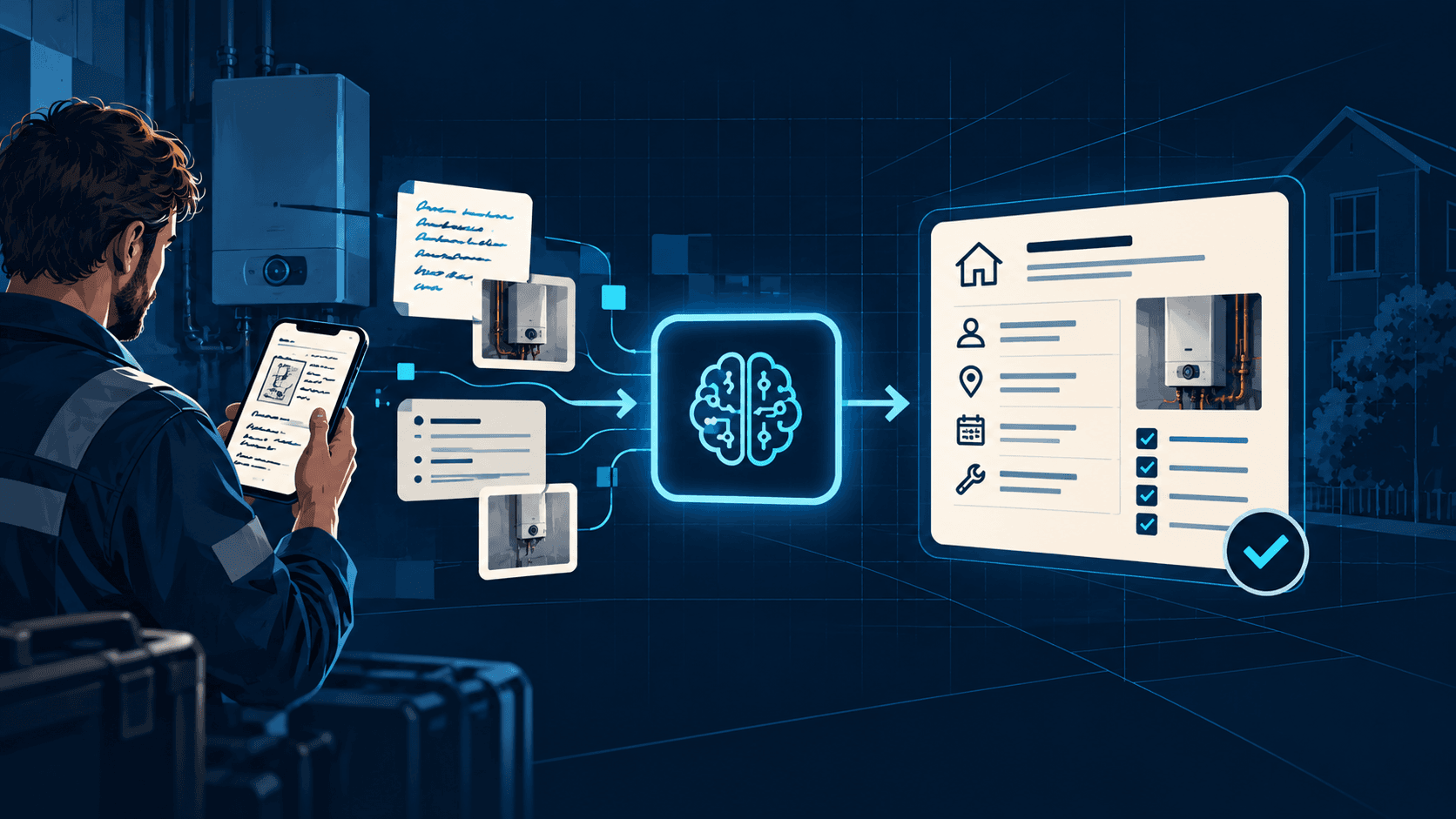
That division gives us a simple principle: AI reads the notes. Code controls the record. AI handles the part that benefits from flexible interpretation, and code handles the parts where the rules can be known.
An unknown record is not an AI reasoning problem
Consider an engineer who submits a job number that does not exist in the available Jobs data. It might be tempting to ask AI which job they probably meant, and sometimes it would guess correctly. A language model's best guess should still not decide which business record gets modified, so in our demonstration an unknown job goes to Review and the Jobs data remains unchanged.
Far from being a failure of the automation, this is the system correctly recognising that the available information is insufficient for a deterministic decision. A person with access to the appropriate context can then resolve the ambiguity.
AI failure should not have to become data failure
The same principle helps when the model itself produces something unexpected. If an AI-generated result cannot satisfy the requirements of the surrounding software, the system does not have to pretend everything worked: the output can be rejected, the item sent for review and the source information kept available. Without validation, a model can quietly become an authority over the data. With appropriate controls it becomes a useful interpretation component inside a larger system, which is a much easier system to reason about.
Keep the source evidence
When AI transforms unstructured information into structured data, the original still matters. If an engineer's notes say "Replaced valve, tested system, all working. Customer mentioned radiator upstairs still slow to warm.", the structured result might separate that into work completed and a possible follow-up. That is useful, but the original note provides the context. If somebody later needs to understand why a field contains a particular value, the source lets them assess what the AI interpreted. Structured data is convenient for systems and source evidence is valuable for people, and good automation does not have to choose between them.
Human review can be an intentional route
A common mistake in automation projects is to treat every remaining manual step as something to eliminate, which encourages systems to make decisions they do not have enough information to make. Review is sometimes the correct destination. What matters is whether the system has removed the unnecessary work before the item reaches a person. If AI has already interpreted the notes, validated what it can and identified exactly what remains unclear, the person resolving the exception has a much smaller task, and that is still valuable automation.
The pattern extends far beyond engineer notes
Post-job administration is only one example. The same architecture applies wherever a business needs to convert messy human information into structured data: customer enquiries, inspection notes, sales notes, support cases, supplier documents, application forms, meeting notes, maintenance records, property information, claims and internal requests. The exact controls will differ, but the architectural question stays the same. Which parts require interpretation, and which require authority? AI may be excellent at the first without that meaning it should own the second.
Deterministic software still matters in an AI system
It is common to talk about AI as though conventional software has become less relevant. In many useful business systems the opposite is true, and the more flexible the AI component becomes, the more valuable the deterministic boundaries around it are. Schema validation, record matching, permissions, routing, business rules, audit information, exception handling and API contracts are part of how AI becomes usable inside dependable software, not old-fashioned alternatives to it.
Build around what can actually be known
The goal of business automation should not be to make every field look complete or every process appear autonomous. It should be to make the process more useful while preserving the integrity of the information it depends on. That means distinguishing between what the source actually says, what AI can reasonably interpret, what software can determine with certainty, and what still requires a person to decide.
When those responsibilities are clear, AI becomes easier to trust, because it is no longer being asked to pretend it knows more than it does. That is the principle behind our post-job administration demonstration, and we believe it applies much more widely: use AI to understand the information, and use deterministic software to control what becomes part of the business record.